Popular Posts

Showing posts with label Buckingham Palace. Show all posts

How long have you been out here for?

'How long have you been out here for?' A reporter asked, as she shoved a microphone into the face of a woman wearing a union jack hat with a homemade banner attached to the railings. Clearly enjoying the attention the woman smiled, giving the same answer she probably gave to all reporters who came by. 

Other reporters and camera crews were doing similar things to anyone with a creatively decorated sign or tent. Cameras were set up on scaffolds surrounding the Victoria memorial. Those that weren't were in the green media studios set up to cover the event outside Buckingham Palace. Groups of people stood behind those studios, waving signs and cheering to get on TV. Occasionally the crowd would be rewarded with a smile and a wave from the on-air personality.

Just off to the side of these studios, behind gates, stood huge satellite dishes and news caravans that hummed. Walking along Constitution Hill, Green Park, a peaceful retreat from the hoopla. Shaded, cool and quiet it didn't seem as though it was in the same area. Walking back towards Buckingham Palace, it was warm outside and I wished I'd left my coat back at the hotel. Except that it could, and did, turn cool at times.

There was an enormous amount of people, though not as many as there would be this time tomorrow. Nothing was happening. Maybe they were here for the same reason I was. Not to stake a claim on the pavement but to observe, take pictures and like me, savor the moment of just being there.

© Marilyn Braun 2011

Thank you for enjoying this article. If you use the information for research purposes, a link to credit the work I've put into writing it would be appreciated.

Whatever you do, don't go to sleep!

'What ever you do, DON'T go to sleep!'

My husband's warning came into my head as I started to doze off in the hotel room. Just five more minutes I thought to myself. It was 10AM London time, 5AM back home. I had barely slept on the flight. No wonder I was tired. At least I had survived the underground. Mainly thanks to the kindness of strangers, something I would rely on many times through this trip.

But I hadn't come to London to sleep. I sat up, grabbed my cell phone and camera and headed out the door. My hotel was near enough to Buckingham Palace, about a 15 minute walk. I didn't need a map to find it. I only needed to look down the road to see the royal standard flapping in the wind.

As I walked along the sidewalk, multiple souvenir shops caught my eye. William and Kate on every conceivable item imaginable. There were knockoffs of Kate's ring, knockoff commemorative coins, hats, magnets, and condoms. Yes, condoms - holy buzz killer!

Heading further along I found a tea shop selling William and Kate tea bags, then the Buckingham Palace shop. Utopia for those searching for the tasteful items. The store was small and crowded and I hugged my purse close to my body lest I knock over something tastefully expensive.  I made a mental note to come back when it was less crowded.

A few blocks down the road I finally arrived at Buckingham Palace. The Queen's Royal Standard on the flagpole. Beyond the imposing black gates an immaculate gravel forecourt. And there was the famous balcony. By this time the next day, the newly married William and Kate would share a kiss for the world to see.

By the looks of it, I wasn't the only one imagining the same thing.

© Marilyn Braun 2011

Thank you for enjoying this article. If you use the information for research purposes, a link to credit the work I've put into writing it would be appreciated.

The Royal Report for Sunday March 20th, 2011 - Royal Focus: Buckingham Palace

One of the most famous landmarks in the world, Buckingham Palace is the Queen's official London residence. Did you know that the palace has 775 rooms? Or that it has its own cinema, post office and chapel? Come behind the gates and learn more about Buckingham palace on this episode.

You can listen to the episode here:

Royal Focus: Buckingham Palace

Publications mentioned

Hello! Canada Weekly No 210 21 March 2011

Website mentioned

The Official site for The Royal Wedding of Prince William and Catherine Middleton

From My Royal Collection

Buckingham Palace The Palace And Its Royal Residents In Photgraphs

Resources used to research this episode

The Official Website of the British Monarchy - Royal Residences - Buckingham Palace

The Royal Encyclopedia

Buckingham Palace: The Place and the People

Inside Buckingham Palace/the Private World of the Royal Family

Crown and Country: A Personal Guide to Royal London

Tune in live to the next episode of The Royal Report on Sunday March 27, 2011 at 9:00PM EST (North America)

The topic will be: With the well documented marital history of the House of Windsor, does Prince William and Kate Middleton's marriage stand a chance of being successful?

© Marilyn Braun 2011

Question: The Queen's Personal Flag


Last week on television I caught a brief glimpse of old footage of the Royal Family on the balcony at Buckingham Palace, under the balcony was a large banner with Royal Insignia. The banner was blue and it had various insignia, mostly round, and it looked like the banner was in embroidery and goldwork. Do you know anything about this banner?


It sounds like you're referring to the Personal Flag of Queen Elizabeth II. This particular flag was created in 1960, It was flown for the first time on the BOAC Britannia in which she landed at Delhi airport on January 21, 1961. The personal flag consists of the initial 'E' ensigned with the Royal crown, surrounded by a chaplet of roses. The design is in gold (or yellow) on a blue field and the flag is fringed with gold (or yellow).

The Queen has standards for her various realms. The Royal Standard, which is flown whenever she is in residence at one of her Royal palaces, her car on official journeys and her aircraft - when on the ground. The Royal standard represents not only the Sovereign but also the United Kingdom. Her personal flag is meant to symbolize her as an individual instead of associating her with her role as sovereign of any commonwealth realm.  This is personal to her alone and cannot be flown by any other individual. Her personal flag is flown from any building, ship, car or aircraft in which she is staying or travelling.


Although it is not a 'Head of Commonwealth' flag, it has become The Queen's personal Commonwealth flag. A number of Commonwealth countries have adopted their own version of the flag, incorporated to include the country's arms, to be flown as a personal flag when the Queen is visiting their country. Canada's version is at right. It is also flown in non-monarchial Commonwealth countries that have not adopted a personal flag specifically for the Queen.

The design has been adapted - for instance, during her Golden Jubilee celebrations in 2002, a version appeared as a banner on Buckingham Palace (see below). In this case it incorporated the Commonwealth symbol and circles with symbols from her various realms. A fine tribute from the Head of the Commonwealth.


Queen Elizabeth at Golden Jubilee Parade

© Marilyn Braun 2010

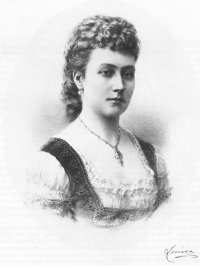
Royal Profile: Princess Louise, Duchess of Argyll

Princess Louise was born on March 18, 1848 at Buckingham Palace, the sixth child and fourth daughter of Queen Victoria and Prince Albert. She was named Louise Caroline Alberta by her father. Louise after her father's mother. Caroline, after Prince Albert's step-grandmother, the dowager duchess of Gotha. And Alberta after himself. During her early childhood she was called "Loo-Loo".

Of Queen Victoria's five daughters she was considered the prettiest, the wittiest, and the best-dressed. She was also the most independent-minded and tempermental.

She was educated by governess at Windsor Castle in arithmetic, history, geography, grammar, as well as the art of court etiquette. She did well in French but not in German. She was considered to be the most artistic of the Queen's daughters and her mother, recognizing her undeniable talent, reluctantly allowed her to attend the Kensington National Art Training School in 1868, becoming the first monarch's daughter to be publicly educated. She eventually became an accomplished sculptor, writer and artist, designing a marble sculpture of her mother which stands at Kensington Palace overlooking the Round Pond and a monument in St. Paul's Cathedral to the fallen of the Boer War of 1899-1902.

Despite her talent, in her mother's eyes, her first duty was to marry. Instead of a foreign princeling, Queen Victoria looked to aristocratic circles. A non-royal match was considered rather novel at the time and had not occurred in the royal family in over 350 years. She married John Douglas Sutherland Campbell, Marquess of Lorne and heir to the Dukedom of Argyll on March 21, 1871 in St. George's Chapel, Windsor. He was known as Ian when he was younger but was called Lorne, after the courtesy title be bore, and he belonged to one of the oldest and most prominent families in the kingdom. The public looked forward to the wedding, Louise being called "The Maiden All for Lorne," and a London perfumer created a scent for the occasion called "Love-Lorne." The couple spent part of their honeymoon at Claremont House near Windsor and then took a tour of the Continent. She became Duchess of Argyll when her husband succeeded to the dukedom in 1900. The couple would have no children.

In 1878 Lorne was offered the governor-generalship of Canada. In addition to their official duties, the couple hosted sledding, sleighing, skating parties at Rideau Hall, and went canoeing and salmon-fishing expeditions. Princess Louise set up her own art studio at Rideau Hall, and encouraged the foundation of the Canadian Academy of Arts in 1880. During her husband's tenure as Governor General of Canada, regiments such as Princess Louise's Dragoon Guards, Quebec's Louise Embankment, Lake Louise in Banff National Park, and the province of Alberta were named after her.

Always interested in women's rights she founded the Ladies' Work Society, where women learned crafts of needlework, embroidery, thus enabling them to earn wages. She also sponsored an "Education Parliament" which became the Girls' Public School Day Company, where middle-class parents were given financial assistance to educate their daughters.

Her husband died in 1914 and she lived at Kensington Palace until her death on December 3, 1939 at the age of ninety-one. She was cremated and her ashes are buried in the Frogmore burial grounds.

© Marilyn Braun 2006