Popular Posts

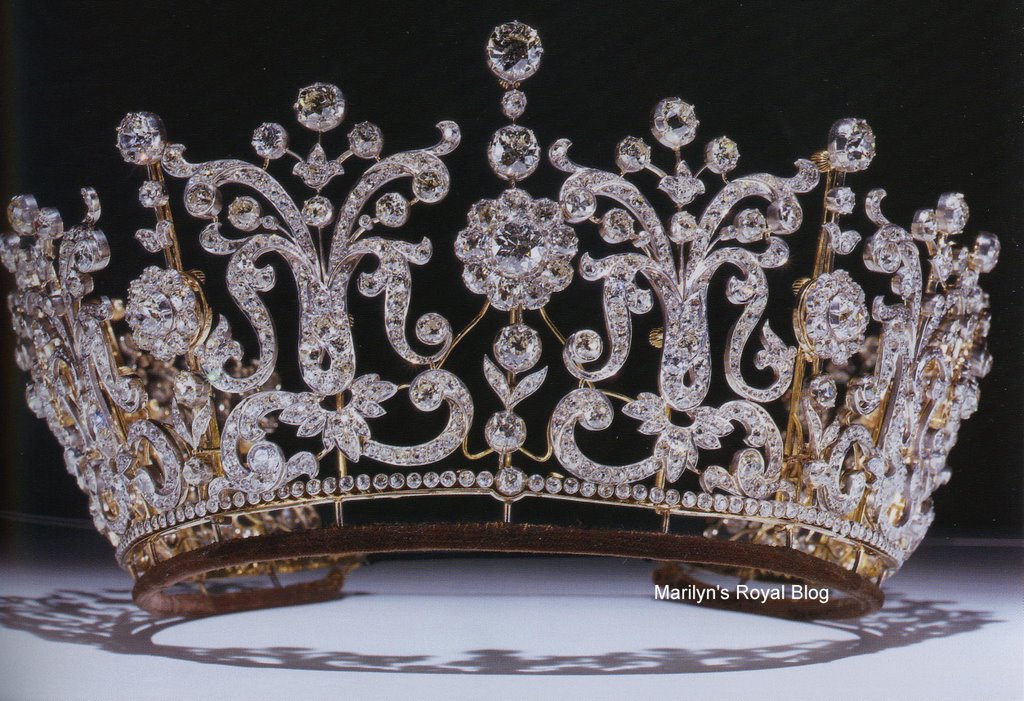
Royal Focus: The Poltimore Tiara

It isn't very often that British royal jewellery goes to auction. The 1987 Sotheby's sale of the Duchess of Windsor's collection could be considered to be the last significant auction. However, in June another sale will be taking place when Christie's International auctions off over 800 items of the late Princess Margaret's jewellery and works of art collection. And if you are the lucky bidder, you could own a memorable piece of royal history.

Amongst the beautiful jewels that Princess Margaret wore in her lifetime, the Poltimore tiara was unquestionably the most striking. She wore it many times throughout her life, but it was most famously worn for her wedding in 1960. The Princess made a stunning bride in her silk organza dress. Unlike other royal wedding dresses it was simple in its design and this simplicity was underlined by the Poltimore tiara.

It is interesting to note that this particular tiara did not come from the royal vaults; but it was acquired specifically for Princess Margaret in 1959. Sold at Sotheby's by the fourth Baron Poltimore's daughter, the Hon. Lady Stucley, it is rumoured to have cost ₤5000.

This neo-classical tiara, was made by Garrard in the 1870's for Florence, the wife of the Second Baron Poltimore, treasurer to Queen Victoria's household. The Diadem features scrolls, leaves and flower clusters and is set on a row of small diamond collets.

The versatile Poltimore can also be worn as a small circlet, necklace and it can be taken apart to form two large corsage brooches. Perfect for those of us who don't have many opportunities to wear tiaras.

© Marilyn Braun 2006

Royal Review: Philip and Elizabeth - Portrait of a Royal Marriage by Gyles Brandreth

I don't normally buy biographies of royal subjects and I rarely read them. Mainly because they tend to have too many sensationalized details already written about in dozens of other books. For the most part it's the same story, different dustjacket. If it does deviate from chronological biography, the books tend to be a forum for the onesided and venemous viewpoints of the author (example: Charles - Victim or Villain by Penny Junor).

Claiming to know his subjects personally and with the promise of no unnamed sources, I decided to read Philip and Elizabeth: Portrait of a Marriage. Ultimately the title 'Portrait of a Marriage' is a bit deceptive, as the book becomes more about Prince Philip than it does on his relationship with the Queen (see list of Prince Philip's Achievements at the end of the book). In this case, it's not much different from Basil Boothroyd's Philip: An Informal Biography. Of course that was 35 years ago, so 'Philip and Elizabeth' continues where Boothroyd left off.

The book begins with the life stories of Prince Philip and the Queen, but none of the information is unique; it can be found in any biography. The story of their romance and courtship comes across as seemingly one-sided. As the Queen does not give interviews, we are left with Philip's unsentimental and pragmatic view of the relationship . Prince Philip is quoted in the book as saying "I suppose one thing led to another, it was sort of fixed up. That's what really happened." Considering that this book is supposed to be a 'Portrait of a Marriage' we are left with little to go on regarding its genesis. We are reminded several times throughout the book that Philip is not inclinded to introspection, nor recollection, which becomes tiresome after a while and makes it frustrating to get an accurate picture.

Any juicy information is prefaced by the author ("Although it's really none of your business..." or "Of course we don't need to know. It's none of our business..."). True but then why write a book in the first place? With only one half co-operating with the author, we are left with friends and relatives of the couple to fill in the blanks. To understand his subject better, the author resorts to some misguided psychoanalysis of Prince Philip, but with no clear insight.

Their relationship with their children has its own chapter, and other than Prince Charles' side of the story in his own book by Johnathan Dimbleby, we are left with the impression that, given the circumstances of their lives, the children had a fairly normal and pleasant upbringing. "We did the best we could" is Prince Philip's reply. Although the media would have us believe that the Queen and Prince Philip are distant and cold parents, they come across as anything but. Understanding and sympathetic, these qualities are particularly evident in their relationship with Diana.

Rumours about their married lives and Philip's affairs are addressed. The author makes a valiant attempt to dispel notions by interviewing friends, relatives, some of the women in question and the Prince himself, with rather unsatisfying results. It's hard to take the conclusions at face value when these women are referred to as Prince Philip's "play-mates".

Despite this, I believe the author has maintained an objective viewpoint of his subject. He does not sensationalize any aspect of their lives. But it is only towards the end of the book that the portrait comes into its own. After almost 60 years of marriage, the Queen and Prince Philip are revealed to be a couple who are different, yet friends. Happy, they respect, understand, and complement each other.

And with their share of ups and downs, following the path towards this conclusion makes this book enjoyable to read.

© Marilyn Braun 2006

Royal Profile: Marion Crawford

Marion Crawford was the governess of the Queen and Princess Margaret when they were children. But she is more famous for being one of the first insiders to write an intimate account of royal life by publishing The Little Princesses.

She was born on June 5, 1909 in Woodside Cottage near Kilmarnock in Ayrshire. The daughter of a mechanical engineer's clerk, her father died when she was a year old. Her mother remarried when she was six and the family then moved to Dundermline in Scotland.

She trained as a teacher at Moray House Training College in Edinburgh, (now part of Edinburgh University) and she had originally intended to become a child psychologist. While on leave from her studies, she worked as a temporary governess to the children of Lord Elgin and tutored the daughter of Lady Rose Leveson Gower; the sister of Elizabeth, Duchess of York (later the Queen Mother). Two weeks after meeting the Duke and Duchess, she was asked to take on the education of Princesses Elizabeth and Margaret, who were five and two at the time. She joined the royal household in 1933 and stayed for sixteen years. Affectionately named 'Crawfie' by her royal charges, she taught Bible, History Grammar, Arithmetic, Geography, Literature, Poetry, Music, Drawing, Writing and Composition.

She became engaged to George Buthlay, a divorced Major from Aberdeen. Fifteen years her senior, he had served in the Middle East during the war. They were married on September 16, 1947 in Dunfermline Abbey. She retired in 1949 to a grace and favour residence, Nottingham Cottage, at Kensington Palace and was made a Commander of the Victorian Order in January 1949 by King George VI.

At the time royal servants were paid very little and it was thought that serving royalty was its own reward. Convinced by her husband that she was being taken advantage of, she went against Queen Elizabeth (the Queen Mother's) wishes by writing The Little Princesses. As a result, she was shunned by the royal family and their circle. She went on to publish a life of Queen Mary (The Queen Mother) in 1951. In 1952 and 1953, she sold her name to a series of articles: Queen Elizabeth II, Happy and Glorious and Princess Margaret. She also had her own weekly column 'Crawfie's Column' but her career as a royal columnist ended when, on June 16, 1955, Woman's Own published her personal accounts of the Trooping the Colour and Royal Ascot; events which had been cancelled due to the National Rail Strike.

Her husband died in 1977 and she spent her remaining years in seclusion in Aberdeen, making one suicide attempt in old age. She died at Hawkhill House, an Aberdeen nursing home on February 11, 1988. No member of the royal family attended or sent condolences.

© Marilyn Braun 2006