


Tune in to the next episode of The Royal Report on Sunday May 15, 2011 at 9:00PM ET (North America)
The topic will be: What do Norman Hartnell, David and Elizabeth Emmanuel, Lindka Cierach, Molyneux, Mainbocher, and Mme Handley Seymour have in common? All of them designed memorable royal wedding dresses. Sarah Burton from the House of Alexander McQueen has just joined those illustrious ranks. On this episode, a look back at royal wedding dress designers
© Marilyn Braun 2011
Thank you for enjoying this article. If you use the information for research purposes, a link to credit the work I've put into writing it would be appreciated.
Popular Posts
-
Prince Harry#39;s dad is James Prince+harry+james+hewitt+ Prince+harry+james+hewitt+ James+hewitt+prince+harry Prince+harry+james+hewitt+ pr...
-
 kate middleton style blog. Kate Middleton for a truly casual Kate kate middleton style blog. Kate Middleton, style icon, kate middleton styl...
-
 kate middleton style dress. Kate+middleton+style+dress kate middleton style dress. kate middleton style dress. Kate Middleton#39;s Blue Colo...
-
Caroline Flack Empire Caroline+flack Caroline+flack+hair world of Caroline+flack+im caroline flack Caroline Flack Caroline Flack and Ram Vas...
-
Like a princess Kate Middleton Kate Middleton, Princess Princess Kate Middleton in Kate Middleton will be living Princess Kate Middleton And...
-
of Prince Harry, Rapidshare mbdec , tv presenter caroline Harry meet uk tvs rockin new saucepot Caroline+flack+bo+selecta Pepsidec , flack f...
-
Lucky for Kate Middleton, Ian Stuart wedding gown sketch kate middleton wedding dress bella-swans-wedding-dress- Sketches of Kate Middletone...
-
Prince ||Prince harry squeezing Prince Harry, left, leading Prince Harry and Chelsy prince harry penis size prince harry Is THIS man his rea...
-
Royal Wedding Party Invitation Royal Wedding tea party. +royal+wedding+invite royal wedding invitation, Royal+wedding+invitation This is the...
-
Prince Harry And Pippa Prince Harry Gives His Pal a KISS AND TELL: Prince Harry Prince Harry kissing Zara accompanied Prince Harry, Harry an...
Showing posts with label Royal wedding dresses. Show all posts
Showing posts with label Royal wedding dresses. Show all posts

Kate Middleton's Royal Wedding Dress Prerogative
Out of all of the inescapable royal wedding coverage, Kate Middleton's royal wedding dress is the subject of endless speculation. Who will design it? What style will she wear? And on and on it goes..
Royal Wedding dresses are the subject of intense speculation and this rabid desire for information is nothing new. In the absence of any real news, media outlets try to desperately get the scoop on what this dress will look like with the chosen designers resorting to subterfuge to avoid leaks.
Case in point, the designers of Diana, Princess of Wales' wedding dress resorted to hiring a safe and a security guard to protect the dress while it was being made. They would try to throw the press off the scent by putting fabric swatches of different colors in their garbage. Samantha Shaw, who designed Sophie Rhys Jones' wedding dress, quietly disappeared to a secret address to complete the project, Norman Hartnell, who designed Princess Elizabeth's dress in 1947, white-washed the windows of his workroom.
Much has been made of why Kate has not announced the name of her designer. But looking at the experiences of previous royal wedding gown designers, it's difficult to blame Kate for wanting to avoid putting a designer through the ordeal. But Kate has many designers who would love the commission. Rumor has it that Kate has already chosen a designer or at least has a short list to choose from. One of them is reportedly Bruce Oldfield, a favorite of Diana, Princess of Wales. However with his multiple media appearances it's unlikely he's been commissioned to design Kate's dress.
But previous royal brides, such as Princess Anne, Diana, Fergie and Sophie have chosen relatively little-known designers. Maureen Baker was the chief designer for Susan Small, made Princess Anne's 1973 wedding dress. The Emmauel's had graduated from the Royal College of Design four years before Lady Diana Spencer approached them. Lesotho born Lindka Cierach's first commission was a wedding dress for a Bahrain princess, but she received global acclaim as Sarah Ferguson's designer. Low profile society designer Samantha Shaw made Sophie Rhys Jones' 1999 dress.
It would not be surprising if Kate followed the trend and chose a little known designer for her own dress. Unlike Bruce Oldfield, they may shun publicity to focus on the quality of the dress and maintain the discretion that Kate is entitled to on her wedding day.
Fingers crossed she gets it.
© Marilyn Braun 2011
Royal Focus: The Duchess of Windsor's wedding dress

Made of sapphire blue silk crepe, the dress was cut simply and was floor length, flaring out at the feet like a mermaids tail. Flute-draped into a heart shape at the bust it had a matching long sleeved jacket fastened with a line of covered buttons the size of shelled peas. The original color of the dress was a color that Mainbocher had created for the Duchess called 'Wallis Blue," to match the Duchess's eyes.
Her hat was a blue straw bonnet trimmed with pink and blue coq feathers by Caroline Reboux. Her pale blue crepe wrist-length gloves opened up on the ring finger of her left hand. On her feet she wore powder blue suede pumps with three-inch heels by Georgette of Paris. Although the dye on the dress has faded, the shoes and the coq feathers decorating the hat have retained their color.
 On her wedding day, Wallis Warfield (she had changed back to her maiden name) wore the sapphire and diamond 'marriage contract' bracelet on her right wrist.On her left wrist she wore a diamond bracelet with Latin crosses. At the throat of her blue crepe wedding dress, she wore an art deco geometric style curving double clip with oval sapphires and radiating baguette diamonds. This brooch was made by Van Cleef in 1936.
Shortly after the wedding copies of the Duchess of Windsor's wedding dress, which reportedly cost $250, were being sold in various department stores. Like other royal brides. Even on her wedding day she was a trend-setter.
In 1950 the original dress was donated to the Metropolitan Museum of Art.
In 1950 the original dress was donated to the Metropolitan Museum of Art.
© Marilyn Braun 2011
Image of wedding dress via http://www.metmuseum.org/
Wedding day image via Wikipedia
Royal Focus: Princess Diana's Wedding Dress
 When people attempt to describe the wedding dress of Diana, Princess of Wales, the words voluminous, iconic, meringue, fairy-tale tend to be used. But it's difficult to put into words the impact of it both on fashion and on the memory of those who watched Diana alight from the carriage, as if a 'butterfly emerging from a chrysalis'. Unlike any royal wedding dress before or since Diana's will always be in a league of its own.

 The dress, designed by David and Elizabeth Emanuel, took four months to make and was made of ivory pure silk taffeta. The bodice was fitted and boned with a wide frill around the curved neckline. It has embroidered lace panels on the front and back. The sleeves are full and gathered into a taffeta frill at the elbow with lace flounce underneath. The skirt of the dress as full, worn over a crinoline petticoat consisting of many layers of ivory tulle and trimmed around the waist and hem with embroidered lace.
 The train, trimmed with lace, was 25-feet long - the longest to date.
The veil, measuring 11 1/2 foot by 40 foot, was hand-embroidered with 10,000 3mm mother-of-pearl sequins. Diana wore the Spencer family tiara for something borrowed. The something old was a piece of lace from Queen Mary, and for something blue, the Emanuel's hand-sewed a little blue bow into the back of the dress. The couple also added a tiny,golden horse-shoe made of 18-carat Welsh gold, studded with diamonds, sewn into the back of the label of the dress.
 Diana carried a large, cascading bouquet. On her feet Diana wore slippers by Clive Shilton. Trimmed with lace from the dress, and made of silk duchess satin, dyed to match the color of the dress, the shoes had 542 mother-of-pearl sequins on each pair, each knotted by hand. The fluted heel was made of bits of leather and wood and the soles were hand-painted with the letters "C" and "D" entwined with a heart.
© Marilyn Braun 2010
Thank you for enjoying this article. If you use the information for research purposes, a link to credit the work I've put into writing it would be appreciated.
Royal Focus: Queen Elizabeth II's Royal Wedding Dress
 When Queen Elizabeth II, at the time Princess Elizabeth, married in 1947, her wedding dress was a stunning creation despite the post war austerity and strict rationing laws. Princess Elizabeth herself was not exempt from the rationing and reportedly saved her clothing coupons for her wedding dress. She received an extra two hundred coupons from the government and many loyal subjects sent in their own coupons. However, it was illegal to give away clothing coupons and the princess returned them to their rightful owners with a note of thanks.
The wedding dress was made by Norman Hartnell and the design was inspired by an image of Primavera by the painter Botticelli. The figure, with its trailing garlands of jasmine, smilax, syringa and rose-like blossoms - was derived from the classical godess of flowers, Flora, and suggested to him the promise of growth and new beginnings.
 Hartnell started work on the dress in August, a mere three months before the wedding in November. Although he was no stranger to designing dresses for royalty, this comission had its share of unique challenges and he had to white-wash the windows of his workroom to keep the dress under wraps. Requiring some materials from the United States, Hartnell sent his manager, Captain Mitchison in his place. Upon his return, when asked if he had anything to declare, Captain Mitchison replied that he had 10,000 pearls for Princess Elizabeth's wedding dress. When the chosen fabric for the dress was publicized, some demanded to know the nationality of the silkworms; whether they were from 'enemy' territories such as Japan or Italy. A crisis was averted when it was confirmed that the larvae had been supplied by China.

Despite these obstacles the dress was a triumph. Decorated with 10,000 pearls, the ivory dress of duchess satin was in the Princess style with a fitted bodice and the neckline had a deep-scalloped edge. The front bodice was cut in three panels and the back cut in four, fastening down the centre back with buttons and loops. The wrist-length, tight-fitting sleeves ended in embroidered cuffs. From the low-pointed waist, the skirt, cut on the cross, extended to a deep circular train.
 The 15-foot star patterned silk tulle train, fastened at the shoulders was embroidered with crystal and appliqué duchesse satin Working with his head embroideress, Hartnell laid tracing paper out on his workroom floor and carefully marked out the pattern in pencil. The white York roses were padded satin, and the ears of corn and orange blossom in diamante and pearl embroidery, inspired by Primavera. The long veil was held in place by a diamond fringe tiara, lent to the Princess, as something borrowed, by her mother, the Queen. She wore two pearl necklaces (the Queen Anne and the Queen Caroline pearls) given as a wedding gift by her parents, and pearl and diamond earrings, a twentieth birthday present from Queen Mary.
She wore ivory duchesse satin high-heeled sandals, trimmed with silver and seed pearl buckles, made by Edward Rayne. Her floral bouquet was supplied by the Worshipful Company of Gardeners and made by Martin Longman, consisted of white orchids with a sprig of myrtle, taken, as per royal wedding tradition, from a bush at Osbourne.
Wedding dress images from PicApp.
Primavera by Botticelli image via Wikipedia.
Royal Focus: Sarah Ferguson, Duchess of York's wedding dress
When asked about her wedding dress in 1986, Sarah Ferguson said "there will never be a dress to match it." And to date she has been correct.
Her dress was designed by Lindka Cierach and was made from heavy ivory duchess satin, which was manufactured at Britain's only silk farm, Lullingstone near Sherborne in Dorset.The fabric was chosen because, according to Sarah 'it is the creamiest material in the world. It never creases. It is as smooth as glass and hangs beautifully.'
 The champagne color of the dress flattered the bride's hair and skin tone. The design had a renaissance silhouette and the fitted, boned bodice had a dropped waist coming into a point at the front and a lower 'V' at the back. The neckline was gently curved and edged with pearls. The sleeves were full, coming into a simple pearl-edged point just below the elbow.
The skirt was flat in front, widening on the sides and full at the back. The 17 1/2 foot train flowed from beneath a fan shaped bow and the underskirt was bordered by a silk scalloped lace flounce billowing out the heavy sheen of the satin skirt. The designer's hallmark - heavy beading - was most strikingly evident on the train and was based on Sarah's Coat-of-Arms. Worked in seed pearls and diamante, the train was embroidered with thistles, bees and hearts and in a nod to Prince Andrew's naval career, anchors, and waves. Rising in a scale at the bottom of the train, a heraldic 'A' led into a double 'S'. The pure silk tulle veil had scalloped edging and was embroidered with true lover's knots and shimmered with sequins. The total number of bugle beads, sequins, crystals pearls and stones on the wedding dress amounted to 155,000.
The satin shoes were designed by Manolo Blahnik and beaded with bees and ribbons in pearls and diamonds. She wore a necklace of cultured pearls intertwined with 18 carat gold and a diamond pearl pendant. She wore a headdress off fresh flowers - roses, lily petals , gardenias (Andrew's favorite flower) and lilies-of-the-valley. At the end of the ceremony the headdress was removed to reveal a diamond tiara, symbolic of her metamorphosis from commoner to royal. As Sarah recalled 'I had stepped up as the country girl; I would walk back as a princess.'
In her hands Sarah carried an "S' shaped spray of cream lilies, palest yellow roses, gardenias, lilies of the valley and the traditional sprig of myrtle.
© Marilyn Braun 2010
Thank you for enjoying this article. If you use the information for research purposes, a link to credit the work I've put into writing it would be appreciated.
Resources
Their Royal Highnesses the Duke & Duchess of York by Christopher Warwick and Valerie Garner

Royal Style Wars : The Trend-Setting Fashion Feud Between the Princess of wales And the Duchess of York

Royalty in Vogue by Josephine Ross

My Story by Sarah, Duchess of York

Invitation To a Royal Wedding ( Sarah Ferguson, Prince Andrew by Trevor Hall

Official Celebration of the Royal Wedding by Gordon Honeycombe

Royal Wedding Bouquets
An occupational hazard of marrying into the royal family is receiving thousands of bouquets throughout your royal career. While these flowers may be easily forgotten, the most famous flowers, their wedding bouquets are freeze framed in the official pictures for other future brides, royal and non-royal, to take inspiration from.
Queen Victoria (1840) a small posy made up solely of snowdrops (Prince Albert's favorite flower).
Queen Mary (1893) The bridal bouquet was of rare white flowers, with the old Provence rose 'House of York' predominating. The bouquet also included white orchids, lilies of the valley, orange blossom and a new white carnation called 'The Bride'.
Queen Elizabeth, Queen Mother (1923) Some reports say the bouquet was created by Edward Goodyear and included roses and lilies-of-the-valley with a white rose on either side. Other reports say that the bouquet was comprised of white roses and heather and was made by the Worshipful Company of Gardeners. None of the wedding photos show the flowers because upon entering Westminster Abbey she placed her bouquet on the tomb of the unknown solider.
Princess Marina, Duchess of Kent (1934) A bouquet of lilies
Queen Elizabeth II (1947) Supplied by the Worshipful Company of Gardeners, and made by Longmans florists. It was was made up of three kinds of British-grown orchids: cattleya, odontoglossum and cypripedium - to which was added a sprig of myrtle from a bush at Osborne House, Queen Victoria's house on the Isle of Wight.
Princess Margaret (1960) bouquet comprised of white orchids and stephanotis
Princess Alexandra (1963) Victorian posy of freesias, narcissi, stephanoitis and lilies-of-the-valley
Birgitte, Duchess of Gloucester (1972) bouquet made by her mother-in-law Princess Alice, Duchess of Gloucester. Modeled on a traditional Danish wedding sheaf, it was comprised of white and cream summer flowers bound with satin ribbon.
Princess Anne, Princess Royal - (1973) Bridal bouquet of white roses, lilies of the valley and stephanotis was "something old" —a sprig of myrtle grown on the Isle of Wight from a sprig of Queen Victoria's wedding bouquet—and a bit of white heather for good luck. Second wedding (1992) she carried a posy of heather and wore white blossoms in her hair.
Sarah Ferguson, Duchess of York (1986) Wore a headdress of gardenias (Prince Andrew's favorite flower) during the ceremony. After signing the wedding register she wore a borrowed tiara. In her memoirs she writes: "It was my time to be Cinderella. I had stepped up as the country girl; I would walk back as a princess." The bouquet was an 'S'-shaped spray of cream lilies, palest yellow roses, gardenias, lilies-of-the-valley and the traditional sprig of myrtle.
Sophie, Countess of Wessex (1999) The shower bouquet was created around a new variety of tall lily named after Sophie. The rest was comprised of blown ivory garden roses, scented stephanotis, clustered lily of the valley and ivory freesia.
Camilla, Duchess of Cornwall (2005) Designed by Shane Connolly of Shane Connolly Flowers Ltd For the Service of Dedication she carried a small, simple elegant floral bouquet bound with silk from her dress. Complementing the grey blue of her dress, Auricular flowers in dusty shades of greys and creams with touches of gold, have been mixed with clusters of Lily of the Valley both for the scent and the sentiment. Again, these flowers are cut from English grown plants later to be grown in the gardens at Highgrove. A sprig of myrtle, representing happy marriage, was sent from a well wisher in Cornwall for the bouquet.
© Marilyn Braun 2009
Thank you for enjoying this article. If you use the information for research purposes, a link to credit the work I've put into writing it would be appreciated.
Related articles
Royal Weddings
Royal Wedding Dresses
Question: Princess Diana's wedding bouquet
Question: Queen Victoria's wedding dress and bouquet
Question: Queen Victoria's Wedding Dress and Bouquet
Could you tell me more about Queen Victoria's wedding dress and bouquet?Thank you very much for your question.
On her wedding day Queen Victoria wore a shoulder-free white satin court dress. The bodice had a low, round neck and edging the neckline were narrow rows of piping and the short, full sleeves gathered into double puffs. The fullness of the skirt was taken in at the waist in a series of deep forward-facing pleats. The skirt had a deep panel of Honiton lace at the front, chosen by Victoria to support the declining lace trade. A court train, made of the same silk satin, measured 6 years in length and had a border of orange blossom sprays matching the coronet of orange blossoms from which her veil was suspended. The choice of orange blossom is significant and somewhat prophetic. In the Mediterranean, it was a symbol of fertility; Queen Victoria would later have nine children. In China it was an emblem of purity, innocence, and chastity; bywords for the Victorian era.
Queen Victoria wanted her entire ensemble to be made of materials of British manufacture. Probably the most well known aspect of her dress is the honiton lace used for her veil and for the flounce. The design of the lace is attributed to Wiliam Dyce and a colleague at the Government School of Design in London. It took more than one hundred lace makers six months to make the exquisite lace and the pattern was destroyed so that it could never be copied. Of her five daughters only her youngest, Princess Beatrice, would get to wear it on her wedding day in 1885. The veil was amongst Queen Victoria's most prized possessions and she would eventually be buried with it.
Because her gown and veil were all in white, she is credited with helping to establish a custom of wearing white, which continues to this day. Previously royal brides had worn gold and silver colors in order to express their wealth. Commoners often wore dark colors in order to use their gowns for other special days. It is said that the simplicity of her dress would set a pattern for other royal wedding dresses - although looking at some of the wedding dresses that followed, I would disagree with that. Many royal wedding dresses have been quite elaborate with beautiful embroidery - hardly simple at all. If anything it would be 120 years later that simplicity would return with Princess Margaret's dress in 1960.
As for her bouquet, Queen Victoria carried a small posy made up solely of snowdrops (Prince Albert's favorite flower). It's somewhat unfortunate but I can only find one source for this information. In reference to bridal bouquets, there is a royal wedding tradition of brides including a sprig of myrtle in their bouquets. This bush was grown from a cutting brought from Coburg by Prince Albert. Sprigs have been included in the bouquets of all royal brides since the 1850s.
© Marilyn Braun 2008
Thank you for enjoying this article. If you use the information for research purposes, a link to credit the work I've put into writing it would be appreciated.
Sources:
Royal Wedding Dresses by Nigel Arch and Joanna Marschner. A Historic Royal Palaces publication.
Royal Weddings by Friederike Haedecke and Julia Melchior
Legendary Brides by Letita Baldrige
I Do: 100 Years of Wedding Fashion by Caroline Cox
Britain's Royal Brides by Josy Argy and Wendy Riches
Five Gold Rings - A Royal Wedding Souvenir Album - by Jane Roberts for Royal Collection Publications
Two Centuries of Royal Weddings by Christopher Warwick
Related Articles
Royal Weddings
Royal Wedding Dresses
Question: Princess Diana's Wedding Bouquet
© Marilyn Braun 2008
Royal Wedding Trivia
In honor of the Diamond wedding anniversary of The Queen and Prince Philip on November 20th. Some royal wedding trivia.
- The Queen is the first British monarch to celebrate a Diamond wedding anniversary
- This was the first and only time in British history that an heir presumptive to the throne had been married.
- The Queen was the 10th member of the Royal family to be married in Westminster Abbey.
- An identical copy of her wedding bouquet was made and presented to The Queen on her Golden wedding anniversary in 1997.
- The two Royal kneelers, used during the wedding service, were covered in rose pink silk. They were made from orange boxes, due to war time austerity, and date stamped 1946.
- Trumpet fanfares were introduced for the first time at a Royal wedding in the Abbey.
- The Duke of Edinburgh is only one of a few consorts to reigning female Queens in British history
© Marilyn Braun 2007
Original trivia source: Official site of the British Monarchy
Related articles:
Royal Weddings
Royal Wedding Dresses
Royal Engagement Rings
Royal Focus: The Poltimore Tiara
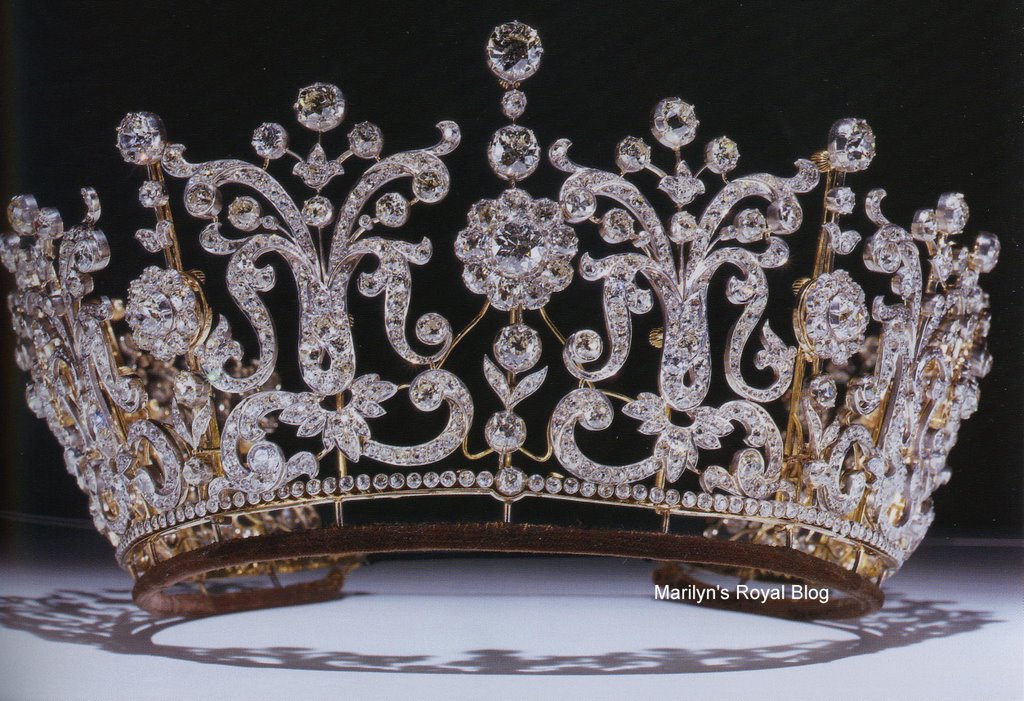 It isn't very often that British royal jewellery goes to auction. The 1987 Sotheby's sale of the Duchess of Windsor's collection could be considered to be the last significant auction. However, in June another sale will be taking place when Christie's International auctions off over 800 items of the late Princess Margaret's jewellery and works of art collection. And if you are the lucky bidder, you could own a memorable piece of royal history.
Amongst the beautiful jewels that Princess Margaret wore in her lifetime, the Poltimore tiara was unquestionably the most striking. She wore it many times throughout her life, but it was most famously worn for her wedding in 1960. The Princess made a stunning bride in her silk organza dress. Unlike other royal wedding dresses it was simple in its design and this simplicity was underlined by the Poltimore tiara.
It is interesting to note that this particular tiara did not come from the royal vaults; but it was acquired specifically for Princess Margaret in 1959. Sold at Sotheby's by the fourth Baron Poltimore's daughter, the Hon. Lady Stucley, it is rumoured to have cost ₤5000.
This neo-classical tiara, was made by Garrard in the 1870's for Florence, the wife of the Second Baron Poltimore, treasurer to Queen Victoria's household. The Diadem features scrolls, leaves and flower clusters and is set on a row of small diamond collets.
The versatile Poltimore can also be worn as a small circlet, necklace and it can be taken apart to form two large corsage brooches. Perfect for those of us who don't have many opportunities to wear tiaras.
© Marilyn Braun 2006
Subscribe to:
Posts (Atom)


