Popular Posts

Showing posts with label Royal Jewels. Show all posts

Royal Focus: The Cullinan V Heart Brooch

KAMPALA, UGANDA - NOVEMBER 22:  HRH Queen Elizabeth II smiles as she tours the Mildmay centre for AIDS Orphans on November 22, 2007 in Kampala, Uganda. The Queen will open the Commonwealth Heads of Government Meeting on Friday. CHOGM will be attended by over 5000 delegates, The Prince of Wales and Duchess of Cornwall as well as UK Prime Minister Gordon Brown.  (Photo by Chris Jackson/Getty Images)The diamond in the Cullinan V Heart Brooch is part of the famous Cullinan cleavings.

The original Cullinan diamond was named after the owner of the Premier mine, Sir Thomas M. Cullinan. The stone was discovered in 1905 by the Superintendent of the mine, who originally thought the stone was nothing more than a piece of broken glass, he dug the rock out. The diamond weighed 3,106 carats and was given to King Edward VII as a 'token of loyalty'. The King accepted the stone 'for myself and sucessors'.

The stone was cleaved into two pieces weighing 1,977.5 carats and the other weighing 1,040 carats. A further cleaving  resulted in nine major stones, known as 'chips'. Some of the chips became part of the Crown Jewels: the pear-shaped Star of Africa (Cullinan I) set into the royal sceptre and the other set into the Imperial State Crown (Cullinan II) . The Cullinan III and Cullinan IV - known as the Lesser Stars of Africa were set as a brooch and is the single most valuable item in the Queen's collection.  She refers to them as 'Granny's chips'. Other stones were set into the Cullinan VII and Cullinan VIII brooches, as well as a marquise shaped ring (Cullinan IX).

One of the chips was used to make the Cullinan V Heart Brooch. The diamond, an 18.8 carat heart-shaped stone, was put into a heart-shaped platinum setting , the collets in the brooch designed to accentuate the shape of the diamond. It was worn frequently by Queen Mary and is said to be one of The Queen's favorite pieces.  

© Marilyn Braun 2010

Royal Focus: The Prince Albert Brooch

401511 18: Britains Queen Elizabeth II smiles at the crowds of well wishers lining the Waitemata Plaza walkway February 26, 2002 in Auckland, New Zealand. The Queen and her husband the Duke of Edinburgh are in New Zealand for six days before travelling to Australia on February 27. (Photo by Dean Treml/Getty Images)

This large oblong sapphire is surrounded by twelve round diamonds. It was given to Queen Victoria by Prince Albert of Saxe-Coburg-Gotha the day before their wedding. For their wedding she wore the brooch with a diamond necklace and earrings and always referred to the jewel as 'Albert's brooch'.

While Prince Albert was alive, Queen Victoria wore it constantly and inexpensive reproductions of it were made for those subjects who wanted to purchase a version of the brooch.  After his death in 1861 she rarely wore it. In her she instructed that it be considered a Crown piece of jewellery, held in trust for all future Queen consorts. Queen Alexandra wore it pinned to her shoulder for her coronation in 1902. Queen Mary wore it often, but Queen Elizabeth, the Queen Mother was rarely seen wearing it. The brooch is a favorite of the present Queen. Prince Albert made copies of the brooch for his daughters and the present Queen gave one of these to her daughter, Princess Anne.

© Marilyn Braun 2010

Royal Focus: The Queen's flame lily brooch

Jun. 05, 2010 - Epsom, Surrey, United Kingdom - epa02188305 Queen Elizabeth II of the UK arrives during the Investec Derby meeting at Epsom racecourse, Surrey, southern England, on 05 June 2010. The Epsom Derby is one of the five British Classic Races. It goes without saying that The Queen has one of the most remarkable collection of jewels in the world. Many of the brooches have a history behind them, such as the Flame lily brooch she wears in this photo.

The Flame lily brooch was amongst the gifts that The Queen, as Princess Elizabeth, received for her twenty-first birthday during her tour of Southern Africa in 1947. Set with three hundred diamonds, the platinum 'Flame lily' brooch was a gift from forty-two thousand Southern Rhodesian school children, who had each donated a week's pocket money.

The shape of the brooch was appropriate, as the flame lily was the national emblem of Rhodesia. In order to make a perfect replica of the lily, which varies in color, a flower had to be specially flown to South Africa where an artist worked against time to complete the reference drawings before it wilted.

It was presented to her during the royal tour at Government House. The next day the Princess wore the brooch on her left shoulder, a compliment that was appreciated by all of those involved in making it. During Princess Elizabeth and the Duke of Edinburgh's trip to Kenya in 1952, her father King George VI died. When the new Queen returned from South Africa, she wore the brooch pinned to the lapel of her black coat.

© Marilyn Braun 2010

The Royal Tour 2010 - The Queen's Jewels

One of the noticeable things about the Queen's appearance is her ubiquitous pearl button earrings, her multi-strand pearl necklace and her brooches. Brooches may have long gone out of fashion as an everyday fashion staple, but not so with the Queen, who has worn several different brooches during her tour of Canada.

HALIFAX, NS - JUNE 29: Queen Elizabeth II attends a reception for 'A Celebration of Novia Scotia' at the Cunard Centre on June 29, 2010 in Halifax, Canada. The Queen and Duke of Edinburgh are on an eight day tour of Canada starting in Halifax and finishing in Toronto. The trip is to celebrate the centenary of the Canadian Navy and to mark Canada Day. On July 6th, the royal couple will make their way to New York where the Queen will address the UN and visit Ground Zero. (Photo by Chris Jackson-Pool/Getty Images)
During a reception in Halifax, The Queen wears what appears to be a newer brooch from her collection. Paying a compliment to Canada, the gold brooch is a branch with red enamel maple-leafs and at the bottom of the branch is a small pearl. A lovely piece, almost shaped like a corsage, she would wear it again later on in the tour during a visit to the Research in Motion Blackberry factory in Waterloo, Ontario. 
Great Britain's Queen Elizabeth and Prince Philip (not shown0 arrive at Parliament Hill as guests of honor for Canada Day celebrations in Ottawa, Ontario, July 1, 2010. The royal couple are on day four of their nine day Royal Tour of Canada. UPI/Heinz Ruckemann Photo via Newscom

Fittingly enough for Canada Day the Queen wore her Maple Leaf brooch - the national symbol of Canada. The large diamond-encrusted maple leaf brooch, was originally presented to Queen Elizabeth, the Queen Mother when she first visited Canada in 1939. The gift of a maple leaf brooch follows a long-standing tradition. In 1901, the future Queen Mary, visited Canada on a seven-month-long tour where she was given an enamel maple leaf spray. In 1923, Queen Elizabeth, the future Queen Mother received as a wedding gift a gold maple leaf brooch set with diamonds.


Great Britain's Queen Elizabeth meets with Michael Ignatieff the leader of the Opposition, federal Liberal party at Rideau Hall in Ottawa, Ontario, July 2, 2010. The Queen and Prince Philip are on day five of their nine day Royal Tour of Canada. UPI/Pool/Neil Valois Photo via Newscom
Not as easily visible in this photo the Queen wears the Duchess of Cambridge's Pendant brooch for her private meeting with Liberal Leader Michael Ignatieff. A baroque pearl in a diamond-set Mount hangs from a diamond pendant below a large round pearl framed by fourteen brilliant-cut diamonds. The brooch, originally belonged to Queen Mary's grandmother, Princess Augusta, Duchess of Cambridge, who was painted wearing it as early as 1877. This brooch was one of Queen Mary's favorites and the present Queen inherited it in 1953.

WINNIPEG, MB - JULY 03: Queen Elizabeth II l smiles as she arrives at the new James Armstrong Richardson International airport on July 3, 2010 in Winnipeg, Canada. The Queen and Duke of Edinburgh are on an eight day tour of Canada starting in Halifax and finishing in Toronto. The trip is to celebrate the centenary of the Canadian Navy and to mark Canada Day. On July 6th The royal couple will make their way to New York where the Queen will address the UN and visit Ground Zero. (Photo by Chris Jackson-Pool/Getty Images)
In this photo, taken in Winnipeg, the Queen wears the Williamson diamond brooch, made for The Queen by Cartier in 1952, as a setting for the world's largest 54.5-carat pink diamond she had been given as a wedding gift in 1947 by John T, Williamson. The diamond had been discovered in Dr Williamson's mine in Tanganyika in the month before the royal wedding. In 1948 it was cut into a 23.6-carat brilliant in London and later set into this daffodil flower brooch - rumored to be one of the Queen's favorite flowers.  


TORONTO, ON - JULY 04: Queen Elizabeth II leaves the Sunday Service at the Cathedral Church of St James on July 4, 2010 in Toronto, Canada. The Queen and Duke of Edinburgh are on an eight day tour of Canada starting in Halifax and finishing in Toronto. The trip is to celebrate the centenary of the Canadian Navy and to mark Canada Day. On July 6th The royal couple will make their way to New York where the Queen will address the UN and visit Ground Zero. (Photo by Chris Jackson/Getty Images)In this photo, taken just outside of St James Cathedral in Toronto the Queen appears to be wearing the Jubilee brooch.  Originally given to Queen Victoria from  'The Ladies and Gentlemen of Her Majesty's Household in celebration of her Diamond Jubilee in 1897. It is a festoon design of diamonds with a pearl centre. It had a pearl drop hanging from a looped chain of diamond collets but this appears to have been removed. Queen Victoria left the brooch to the Crown in 1901. It was frequently worn by the present Queen's mother, the late Queen Elizabeth, the Queen Mother, who had an affinity for diamonds and particularly pearls.

TORONTO, ON - JULY 05: Queen Elizabeth II gives a speech during a dinner at the Royal York Hotel on July 5, 2010 in Toronto, Canada. The Queen and Duke of Edinburgh are on an eight day tour of Canada starting in Halifax and finishing in Toronto. The trip is to celebrate the centenary of the Canadian Navy and to mark Canada Day. On July 6th, the royal couple will make their way to New York where the Queen will address the UN and visit Ground Zero. (Photo by Chris Jackson/Getty Images)In this photo, the Queen wears Queen Mary's 'Girls of Great Britain and Ireland' tiara. She received this as a wedding gift from her grandmother, Queen Mary, in 1947 and it has been referred to affectionately as 'Granny's tiara.'

She is wearing Queen Victoria's Collet Necklace and the King George VI diamond Chandelier Earrings. Ending in three drops, these earrings show every known modern cut of diamond. Like her tiara, she received these as a wedding gift in 1947. In this photo she is most definitely wearing the Jubilee brooch, this time with the pearl drop pendant attached.


NEW YORK - JULY 06: Queen Elizabeth II smiles as she visits the British Garden at Hanover Square on July 6, 2010 in New York City. Queen Elizabeth II and Prince Philip, Duke of Edinburgh have just completed an eight day tour of Canada and the visit to New York is final day before the royal couple head back to the UK. After paying a historic visit to the United Nations they will visit ground zero and the British Memorial Garden. The Queen last addressed the United Nations in 1957 and it will be the first time she has visited ground zero. (Photo by Chris Jackson-Pool/Getty Images)
In this photo, taken during her brief visit to New York City, she wears her Aquamarine and diamond Cartier clips. Combining baguette, oval and round stones, these clips were given to the Queen in 1944 as an eighteenth birthday present by her parents. They can be worn as a single brooch or as two separate matching clips, as she wears them in the photo.

© Marilyn Braun 2010

All photos via PicApp

Royal Focus: Swedish Cameo Tiara

STOCKHOLM, SWEDEN - JUNE 19: Crown Princess Victoria of Sweden attends her wedding banquet at the Royal Palace on June 19, 2010 in Stockholm, Sweden. (Photo by Pascal Le Segretain/Getty Images)On her wedding day, Crown Princess Victoria of Sweden will continue a Bernadotte royal wedding tradition by wearing the Cameo tiara, one of the oldest jewels in the Swedish royal family's collection . UPDATE: Victoria wears the tiara at left


The tiara was made for Empress Josephine, first wife of Napoleon I, by the French Crown Jeweller Marie-Etienne Nitot in Paris in 1811. The gold and seed pearl tiara is set with seven portrait cameos.  The centre oval depicts Venus and cupid. On either side is a portrait of a man and on the other side a portait of a woman, both facing the centre cameo. The hardstone cameos are believed to have been supplied by the jeweller to the Empress Josephine in 1809. Napolean himself was fascinated by cameos and the diadem is an example of the revival of the antique style popular in France in the late eighteenth and early nineteenth centuries.


In 1823 the diadem became part of the dowry of Josephine of Leuchtenberg, who received it from her grandmother and namesake, Empress Josephine, upon her marriage to the future King of Sweden, Oscar I. She is wearing it in the portrait at right.

Carl Gustav  XVI Weds
After the death of Queen Josefina of Sweden in 1876, her jewelry collection was divided up and the cameo diadem was bequethed to King Oscar II of Sweden who gave it to his wife, nee Princess Sophie of Nassau. Queen Sophie gave the cameo diadem to her youngest son, Eugene, who in turn gave it to Princess Sibylla, mother of King Carl XVI. She lent the tiara to her daughter Princess Birgitta who wore the tiara as her bridal crown for her wedding with Prince Johann Georg of Hohenzollern in 1961.Thus starting a tradition.  It has since been worn by royal brides Princess Désirée in 1964 and Queen Silvia, pictured on her wedding day in 1976.
© Marilyn Braun 2010

Thank you for enjoying this article. If you use the information for research purposes, a link to credit the work I've put into writing it would be appreciated.

The Royal Report for Sunday March 14, 2010 - Royal Jewels

They're shiny, they're priceless, they're an object of fascination. On this episode I discuss Royal Jewels.

Listen to the episode here

Films mentioned

Royal Journey (1951)

Canada at the Coronation

From my royal collection

All about the royal family - An illustrated guide compiled and researched by Pheobe Hichens

Blog Posts mentioned

Royal Engagements

Jewels fit for a Queen

Resources used to research this episode

The Queen's Jewels - The Personal Collection of Elizabeth II - by Leslie Field

The Royal Jewels by Suzy Menkes

Tiaras a History of Spendor by Geoffrey C Munn

Queens Jewels by Vincent Meylan

Tune in live to the next episode of The Royal Report on Sunday March 21, 2010 at 9:00PM EST (North America)

The topic will be: Is Kate Middleton a public figure?

© Marilyn Braun 2010

Question: The Duchess of Windsor's Engagement Ring

Image Source: Wikipedia Commons Hello, do you know anything about the engagement ring given to Wallis Simpson from Edward? I think is was an emerald but have never found a photograph of it.

You're right, photos of the emerald ring are scarce! This is the closest image I can find in the public domain.

Yes, it was an emerald ring. The ring itself is a rectangular step-cut emerald with cut-corners weighing 19.77 carats within a stylized leaf border set with brilliant-cut diamonds. It was purchased in 1936 from Cartier and originally had a platinum mount, inscribed: We are ours now 27 x 36. It was remounted in a gold setting by Cartier in 1958.

There are a few books with photos of the ring. The Sotheby's auction catalogue: The Jewels of the Duchess of Windsor sold for the benefit of The Pasteur Institute. There is another book, with a similar title called The Jewels of The Duchess of Windsor by John Culme and Nicholas Rayner. Note that if you want to buy the auction catalogue it needs to have 'sold for the benefit of the Pasteur Institute' in the title. The book by Culme and Rayner is not the catalogue. Both books are well worth the price if you are interested in royal jewels.

Strand books in New York City sometimes has copies of these books, at affordable prices and shipping. I wouldn't go through Amazon or Alibris as they charge exorbitant prices for their rare books.

Also, if you're interested in all things relating to the Duke and Duchess you might want to check out the following website: The Duke and Duchess of Windsor Society.

I hope this has answered your question.

© Marilyn Braun 2009


Thank you for enjoying this article. If you use the information for research purposes, a link to credit the work I've put into writing it would be appreciated.

Related articles:

Question: The Duke and Duchess of Windsor's wedding rings

Royal Engagement Rings

Question: The Duke and Duchess of Windsor's wedding rings

....I have not found, anywhere, any information on the wedding rings of the Duke and Duchess, and this is my query: Is there a photograph, or description of the rings – somewhere? Were the Duke and Duchess buried wearing the rings, or, were the rings auctioned at Sotheby’s with the Duchess’ jewelry (after her death)?

Thank you for your questions!

You're right, there doesn't seem to be a lot of photos of the wedding rings out there. But given the fabulous collection of jewels that the Duchess owned, this is not surprising. While there are some photos of her with a plain ring on her wedding finger, they're not close up. For the most part she seems to have been photographed with her engagement ring; a large flawless emerald cut from the size of a bird's egg that belonged to a Mogul Emperor. So while she might have worn her wedding ring everyday, the size of her engagement ring would have dwarfed it. Looking at wedding photos some of them show her wearing just the wedding ring. Incidentally, the gloves she wore for her wedding were designed to open on the ring finger of the left hand. In some photos during the Second World War, where she is contributing to the war effort, you can see her wearing just the wedding ring. Anything larger would have been inappropriate. Many photos show her wearing gloves so the rings would not be seen. She was said to be rather meticulous about her grooming and she had manicures everyday, but her hairdresser recalled: She hated her hands. She always sat with her hands between her knees trying to hide them. Interesting then that she wore such extravagantly large rings that drew attention to them.

In most books about her there is very little reference to the wedding rings. Considering the circumstances, that would have been a minor detail. One book refers to it as being made from gold mined from the Welsh hills with a platinum copy auctioned in 1987 at Sotheby's. There are several wedding rings listed in the Sotheby's sale: lot #142 lists a 'platinum wedding ring, English, 1937, inscribed 'Wallis 18-10-35 Your David 3-VI-37' the two dates commemorate when the Prince proposed and the date of their marriage. In lot #177 there are 'Four wedding rings, all inscribed'. In photos the Duke of Windsor wears two rings on the fifth finger of his left hand, which seems to be the place royal men wear their wedding rings. Why there are five wedding rings in the auction, and whether one of them would have belonged to the Duke of Windsor is anybody's guess. Maybe he was buried with his but I highly doubt it.

Unfortunately I cannot locate photos specifically of these rings. Your best bet would be to see if you can purchase the auction catalogue which is rare and depending on where you look, very expensive, Sotheby's The Jewels of the Duchess of Windsor sold for the benefit of the Pasteur Institute. Or The Jewels of the Duchess of Windsor, by John Culme and Nicholas Rayner, written after the auction and a more affordable option. You might find photographs there.

Update: Although it's an interesting book, The Jewels of the Duchess of Windsor by John Culme and Nicholas Rayner (written after the auction) does not have a photo of the wedding rings. Nor does the official auction catalogue.

Sources:

The Windsor Style by Suzy Menkes

The Royal Jewels by Suzy Menkes

Famous Jewelry Collectors by Stefano Papi & Alexandra Rhodes

The Windsor Years by Lord Kinross

Edward VIII - The Road to Abdication - by Frances Donaldson

The Secret Life of The Duchess of Windsor by Charles Higham

The Windsor Story by J. Bryan III and Charles J.V. Murphy

Related Articles:

Royal Engagement Rings

Jewels fit for a Queen

© Marilyn Braun 2008

Recommended Books: Royal Jewels

I'll be honest. While I've collected royal books since I was a teenager, it wasn't until about 10 years ago that I developed an interest in Royal Jewels. Royal Jewels were the Crown Jewels - interesting, but who wants to stare at that all day? Royal Orders were just ribbons with pictures on them. Tiara's were just things royal brides wore on their wedding day. Luckily I've changed my views since then.

My article called Jewels fit for a Queen remains the most popular article I've ever written, followed closely by Royal Weddings. There are blogs and websites devoted to royal jewels, people just can't seem to get enough of them. Since I started my blog I've received some questions about royal jewels, here's one as an example. But sometimes I find that the question goes beyond my level of expertise (Yes, it's true, I don't know everything there is to know about royalty!). So if you want to know about royal jewels, where do you go for information? Thankfully there are some wonderful books out there.

The Royal Jewels by Suzy Menkes. This was the very first book I ever bought on the subject and it really and truly inspired me. Covering royal jewels from Queen Victoria's time to 1988. It is fairly comprehensive in terms of the highlights of the wearer, towards the end it features several Appendix, one of which lists all of the jewels worn by The Queen on State and Semi-State Occasions.


The Queen's Jewels: The Personal Collection of HM Queen Elizabeth II by Leslie Field.
I have poured over this book more so than any other book in my collection. That's how fascinated I am with it. This book features the personal jewellery collection of HM The Queen. If you've ever been curious about what she keeps in the vaults, this book will give you a very good idea. I would highly recommend this book as a good starting point on the subject.


Tiara's: A History of Splendour by Geoffrey C. Munn. If you're interested in tiara's and their history then this is the book for you. Covering tiaras from 300 BC to 2001, you could look at this book just for the close-up photographs alone. But there's more to it than that. It shows the evolution of tiara's. There's an entire chapter alone on how to wear tiara's in your hair! I won't lie though, this book is expensive but well worth the price if you're truly interested in the subject. There's also a more condensed version of this book which accompanied the exhibition at the Victoria & Albert museum.

Queens' Jewels by Vincent Meylan. Unlike the previous books I've mentioned, along with British jewels, it also covers royal jewels from Russia, France, Spain, Sweden, Italy, Iran, Austria, Belgium and The Balkans. Yes there are more jewels out there than the British ones! It has a lot of intriguing, rarely seen photos and presents the various jewels and their history in vivid style.


© Marilyn Braun 2008

Royal Wedding Trivia

In honor of the Diamond wedding anniversary of The Queen and Prince Philip on November 20th. Some royal wedding trivia.

  • The Queen is the first British monarch to celebrate a Diamond wedding anniversary

  • This was the first and only time in British history that an heir presumptive to the throne had been married.

  • The Queen was the 10th member of the Royal family to be married in Westminster Abbey.

  • An identical copy of her wedding bouquet was made and presented to The Queen on her Golden wedding anniversary in 1997.

  • The two Royal kneelers, used during the wedding service, were covered in rose pink silk. They were made from orange boxes, due to war time austerity, and date stamped 1946.

  • Trumpet fanfares were introduced for the first time at a Royal wedding in the Abbey.

  • The Duke of Edinburgh is only one of a few consorts to reigning female Queens in British history

© Marilyn Braun 2007

Original trivia source: Official site of the British Monarchy

Related articles:

Royal Weddings
Royal Wedding Dresses
Royal Engagement Rings

Royal Focus: The Spencer Family Tiara

Out of the almost 200 posts I've made on this blog, my article Jewels fit for a Queen is the most popular. In fact, anything on royal jewellery, particularly tiaras, seems to be a popular subject. Not a day goes by where someone doesn't find my site by searching for those terms.

Although worn by several Spencer women, this tiara is most associated with Diana, Princess of Wales. Worn most famously at her wedding in 1981 as her something borrowed. She also wore it all through her official life as a member of the royal family, for state banquets, openings of Parliament, and diplomatic receptions. Diana regarded this tiara as her 'spare', the other being the Lover's Knot Tiara, which she received as a wedding gift from the Queen.. Throughout the later part of her married life, she wore the Spencer tiara more often, taking pride in her Spencer heritage, and also because it wasn't as heavy as the Lover's Knot tiara.

Mounted in gold in the form of scrolling tulips and star shaped flowers, it is decorated with diamonds in silver settings. It has been reported that this tiara is a family heirloom from the eighteenth century, but this is a misconception. Instead, it is a composite of several elements. Of the entire tiara, only two elements at the end are old, and are said to have come from a tiara owned by Frances, Viscountess Montagu and left to Lady Sarah Spencer in 1875. The tiara is thought to have been made in 1767, but the style suggests the 1830s. The central element was a wedding gift from Lady Sarah Spencer to Cynthia, Viscountess Althorp (Diana's grandmother) in 1919. In the 20th century, it was remounted and four other elements were made to match it.

Along with Diana, some of the other brides to wear it on their wedding day include Diana's sister Lady Jane Fellowes in 1978, and Victoria Lockwood, the first wife of her brother Charles Spencer, in 1989.

© Marilyn Braun 2007


Thank you for enjoying this article. If you use the information for research purposes, a link to credit the work I've put into writing it would be appreciated.

Question: The Queen's Pearls

Can you tell me the history of the Queen's pearls?

With the exception of State dinners, if you see the Queen on any public occasion, she will rarely be without her pearl-and-diamond button earrings, a brooch, and her pearls (she wears all three in the photo at right).

The Queen, as Princess Elizabeth, received her first set of pearls, a triple strand, as a young girl. They were given to her in 1935 by her grandfather, King George V, to celebrate his Silver Jubilee. Today, she usually wears these pearls in the daytime.

The other pearl necklaces, that I'm aware of at least, are the ones she received as a wedding gift from her parents, King George VI and Queen Elizabeth. The one string is said to have belonged to Queen Anne, last of the Stuart monarchs. The other to Queen Caroline, wife of King George II. She wore these necklaces on her wedding day in 1947, and they are now worn on informal evening occasions.

An oft told anecdote about the pearls. Having received them as a wedding gift, they were put on display at St. James Palace, along with the rest of the gifts. As she was getting ready for her wedding, she wanted to wear the pearls and realized they were still on display. Shortly before the Princess was to leave for Westminster Abbey, she sent John Colville, her Private Secretary, to collect the pearls.

He rushed down the seemingly endless corridor, hurtled down the Grand Staircase, and ended up in the quadrangle, where he commandeered King Haakon VII of Norway's large Daimler. Although traffic had been stopped since early morning, the crowds were so deeply packed across Marlborough Gate, that the car, even flying its royal flag, had to halt while he fought his way through on foot. When he arrived at the Friary Court entrance to the State Apartments there was only an elderly janitor to listen to his odd story, but he finally allowed Colville upstairs to explain his mission to the men who were guarding the 2,660 presents. The dilemma was: if they accepted is story and he turned out to be a clever jewel thief who had made off with the Crown pearls, they were in trouble; but if they refused to let him have the necklace and it all turned out to be true, they were equally in trouble. There was no one to consult; time was running out, and only after they found his name in the wedding programme as one of the Household officials in attendance on the Princess did they allow him to remove the pearls. *

Thanks for your question!


© Marilyn Braun 2007

Sources:

The Queen's Jewels by Leslie Field *
The Royal Jewels by Suzy Menkes
Official Site of the British Royal Family

More on royal jewels:

Jewels fit for a Queen
Camilla's Tiara

Royal Engagement Rings
Royal Focus: The Poltimore Tiara

Photo: Camera Press/Snowdon

My Favorite Royal Books

I have an extensive collection of books on the royal family. One look at my bookcases, floors and and bedside table, you will note that my tastes are anything but highbrow. I prefer informative, easy to understand books with nice pictures. So, to prove this point, I thought I would compile a short list of my favorite books. As a helpful aside, you can click on the titles to order them.

The Royal Encyclopedia - The authoritative book of the Royal Family - Edited by Ronald Allison and Sarah Riddell. Sometimes the word for word source for Wikipedia articles this A to Z book covers Abbey Court, Holyroodhouse to Zoological Gardens, Regent Park and everything in between. 632 pages of royal information, no royal collection is complete without it. If you don't have it, then too bad for you. So rare, I can't even locate a picture of it. Suffice to say that it's heavy, has the title in gold letters and a nice close up of the Imperial State Crown. Some would say it's wine colored...merlot?..bordeaux?..oh never mind.


Queen Victoria and Her Decendants by Charlotte Zeepvat. I love old photos and this book is chock-full of them. I'm surprised my copy isn't dog eared for all of the time I've..uhh..spent "reading" it. For me, one very interesting aspect of this book is watching various decendants grow from babies to old age.


The Complete Idiot's Guide to British Royalty. A good standby, this book has rescued me from many a confused look when someone asks me a serious question about the relevance of the royal family and what they actually do. Hopefully the recently published British Monarchy for Dummies will fill in any blanks and cover me in all awkward situations.


Tsar: The Lost World of Nicholas and Alexandra by Peter Kurth. Beyond the connection to the Brit's, the Russian royal family is not my forte. This book has beautiful pictures of the various palaces, and the royal family before it all went horribly wrong. The last chapter details the discovery of the Romanov remains and the process to authenticate them. It also has a modern day section on DNA analysis and attempts to answer the question: Was Anna Anderson the Grand Duchess Anastasia?


The Queen's Jewel's by Leslie Field. This is one of my all-time favorite books. Authorized by Buckingham Palace it details the collection of Her Majesty The Queen. Broken down by type of stone, it has gorgeous photos of tiaras, brooches, necklaces, bracelets, along with the history behind these pieces.


Jubilee - A Celebration of 50 years of the Reign of Her Majesty Queen Elizabeth II by Tim Graham. Released to coincide with the Golden Jubilee celebrations. Want to know where the Queen gets her shoes, hats, and coats made? Information on the endless round of engagements the Queen performs? How the Garden Parties are organized? Released in 2002 to coincide with the Golden Jubilee celebrations, this wonderful book tells you about this and much much more!


I could list many many more, but that's another article!


© Marilyn Braun 2007

Royal Engagement Rings

"Diamonds are a girl's best friend", and so the song goes. But royal engagement rings are somewhat different. Despite some fabulous diamonds in the royal collection, the traditional diamond is not necessarily the rock of choice for royal engagement rings.

Symbolizing love and purity, sapphire is probably the most popular stone chosen by royal brides and this choice is somewhat of a tradition in the family. Princess Marina, Duchess of Kent, Princess Alice, Duchess of Gloucester, and Princess Alexandra of Kent who wears an oval star sapphire ring inherited from her mother. Princess Anne, the present Duchess of Kent and Princess Michael of Kent, also had sapphire rings for their engagements. When the Queen Mother became engaged in 1923, she was originally given a sapphire ring, which, in her only interview, she told reporters that it was her favourite stone. In the 1950's she switched to a large pearl ring surrounded by diamonds, similar to a ring worn by Queen Mary until her death.

The Queen wears many priceless jewels, but her favorite is her diamond engagement ring. The diamonds on her ring came from a tiara that had belonged to Prince Philip's mother. Prince Philip was involved in the design and the platinum ring was set with eleven diamonds, a 3 carat solitaire and five smaller stones set on each shoulder. When the engagement was announced, the ring was too big and had to be re sized 2 days before the official photo call. A bit of trivia: it is said that if the Queen is annoyed about anything she will start to twist the ring round and round.

Diana's ring was a large, striking oval sapphire surrounded by fourteen brilliant cut diamonds, set in 18 carat white gold. It has been reported that Diana was offered a tray of rings and she chose this one because it was the biggest. This particular ring inspired copies the world over and at the time the it was estimated to have cost £28,500. She is shown wearing the ring on the day her divorce became final. Prince Harry inherited the ring after his mother's death. At the time of her death it was valued at £250,000.

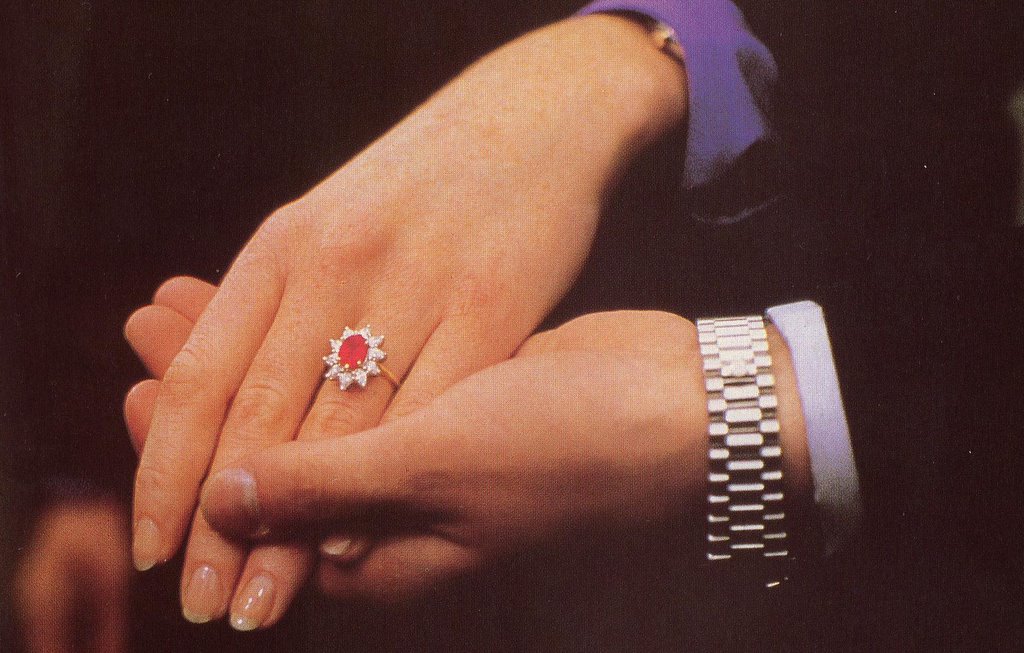
Sarah's ring has an oval Burma ruby, surrounded by a cluster of 10 drop diamonds. The stone was chosen to compliment her red hair. Prince Andrew had originally wanted an emerald ring, but Sarah didn't, so the couple chose a ruby instead. Prince Andrew helped to design it. It is set in eighteen carat yellow and has a white gold band and at the time it was valued at £25,000. In photographs, she can still occasionally be seen wearing the ring. The ruby stone is not chosen for rings very often, because, like opals, in the past the royal family has had superstitions regarding them. Queen Alexandra had a very strong aversion to opals, believing that the brought bad luck. The only other bride to have chosen a ruby engagement ring, in recent history, is the late Princess Margaret.

Sophie's ring features a 2.05-carat oval diamond, flanked by two smaller heart shaped gems, set in 18 carat white gold. Made by the Crown Jewellers, Aspry and estimated at £105,000, it is said to be the most expensive royal engagement ring in history.

Second to the provenance of diamonds in Queen Elizabeth II's engagement ring, Camilla's probably has the most history and sentimental value. The ring is considered to be a family heirloom, and there are estimated values of £100,000. It is in an art deco style, set in platinum, and composed of a emerald cut central diamond flanked by three diamond baguettes on either side. It originally belonged to the Queen Mother, who was given the ring in in 1926 upon the birth of the present Queen.

© Marilyn Braun

Thank you for enjoying this article. If you use the information for research purposes, a link to credit the work I've put into writing it would be appreciated.

Camilla's tiara

Well, the Queen opened her vaults and picked out a tiara to lend to Camilla, and what a tiara! The Delhi Durbar tiara has been seen only a handful of times: the Queen Mother wore it in 1947 during a tour of South Africa, and in 1998, it was displayed at Christie's in aid of charity.

The circlet was made by Garrards, especially for Queen Mary during the Delhi Durbar on December 12,1911 - hence its name. Durbar is Hindi, for a 'ceremonial gathering to pay homage'. The gathering was to install King George V and Queen Mary as Emperor and Empress of India. King George V admired this piece and referred to it as "May's best tiara".

It was originally worn with detachable emerald drops and at the Durbar, Queen Mary wore it over a crimson velvet cap. According to the book Tiara's A History of Splendor by Geoffrey Munn, it is designed as a:

'graduated frieze of lyres and forget-me-not leaves and flowers, emblematic of harmony and love, it once supported not only the Cambridge emeralds but also the third and fourth cleavings of the famous Cullinan diamond. The cushion shaped stone of 62 carats was secured by a wire at the highest point of the jewel and the drop-shaped stone weighing 92 carats hung in the oval aperture below.'

The Cullinan III and IV diamonds are known as the Lesser Stars of Africa, they are the most valuable items owned by the Queen, who refers to them as 'Granny's Chips'. These diamonds are no longer in the Delhi Durbar, but are now set in a brooch, whch is rarely worn by the Queen. Queen Mary's Delhi Durbar crown latterly belonged to the Queen Mother, but upon her death it went into the private collection of the Queen.

© Marilyn Braun

Thank you for enjoying this article. If you use the information for research purposes, a link to credit the work I've put into writing it would be appreciated.

References:

Tiaras - A History of Splendor by Geoffrey C. Munn
Tiaras Past and Present by Geoffrey C. Munn
Queens' Jewels by Vincent Meylan
The Royal Jewels by Suzy Menkes
The Queen's Jewels by Leslie Field

Photo of the Delhi Durbar tiara from: Tiaras - A History of Splendor by Geoffrey C. Munn

Jewels fit for a Queen

Jewels are a pivotal part of any royal woman's wardrobe. The Queen’s jewels might go unnoticed but they are beautiful and fascinating for their history and individual craftsmanship. Over the years the Queen has received a number of gifts, whether personal ones or jewels from heads of state and if she is receives a piece of jewellery she will usually try to wear it to the next occasion as a compliment to the presenter. In public or private, it would be very unusual to see the Queen without some sort of brooch or her pearls. In the evenings she can be seen with some type of royal parure, which is a set of matched jewellery usually comprising of a brooch, earrings, tiara and necklace. The Queen is estimated to have in her collection 14 tiaras, 37 pairs of earrings, 105 brooches, 58 necklaces, 37 bracelets, six pendants, 14 watches, and 15 rings.

Some of the jewels are family heirlooms or belong to the Crown to be worn by future queens. Although there are no official guidelines, jewels which are personal property, are bequeathed at the owner's discretion. Queen Victoria and Queen Mary are in large responsible for organizing the collection, deciding which ones would be personal gifts and which ones would belong to the Crown. Regardless of what public event the Queen attends she is usually wearing something on her head, whether it is a tiara, crown, or hat, as a symbol of authority. It would be impossible to mention all of her jewellery so I will confine this article to the more familiar pieces, mainly tiaras.

When most people think of royal jewels they think of the Crown Regalia, specifically the Imperial State Crown, it is most recognizable as it is worn for coronations and state openings of parliament. This crown weighs 2lbs 13 oz. It is set with 2,873 diamonds, 273 pearls, seventeen sapphires, eleven emeralds and five rubies. The Crown also features the 317.4 Cullinan II diamond and the ‘Black Prince’s ruby’. In its long history at one point the crown was transported by cab and until 1962 it was transported to the Houses of Parliament in a closed carriage. Now it is openly displayed for the waiting crowds, as a prelude to the symbolism and pageantry as the Queen carries out her role as constitutional monarch. When the Queen meets children in public at least one of them is invariably bound to ask her "Where is your crown?"

King George IV State Diadem

The most frequently worn part of the Crown Regalia is the King George IV State Diadem. It is completely circular and decorated with symbolic roses, shamrock and thistle. Originally made for King George IV in 1821 for his coronation, but he never wore it. During the Hanoverian period, gems were hired out for the crowns and then stripped bare leaving skeletal frames between each coronation. In1838 the diadem was reset with jewels from the royal collection and Queen Victoria wore it at her coronation. However, with the beginning of this reign the jewels were soldered in, symbolic of the new solidity and prosperity Queen Victoria would come to represent. She wore the diadem constantly for family events, state banquets, formal portraits, and she is pictured wearing it in the first postage stamp issued in 1840. In her will she left it to the Crown. The diadem was a particular favourite of Queen Alexandra.

The present Queen wore this on her way to her coronation and wears this to and from the State Opening of Parliament each year. She is pictured wearing it on all UK postage stamps and the diadem is no doubt seen by more millions of people than any other item of royal jewellery.

Girls of Great Britain and Ireland tiara

If one looks at photos of the Queen during evening events, you will frequently see the‘Girls of Great Britain and Ireland’ tiara. The tiara gets its name from donations made to a committee formed in 1893 to raise money for a wedding gift to the future Queen Mary. It has diamond festoons, scrolls and 27 collet spikes and Queen Mary originally wore it with upstanding pearl spikes. Minus the pearls, she gifted it to Princess Elizabeth for her wedding in 1947. It was her first tiara and the Queen affectionately calls it ‘Granny’s tiara’. This tiara has also appeared on currency and stamps.

King George III fringe tiara

Princess Elizabeth did not wear 'Granny's tiara' on her wedding day; instead she borrowed the King George III fringe tiara from her mother. A graduated circle of vertical rows of diamonds, it was originally made in 1830 and designed to be worn as either a necklace or a tiara. This tiara/necklace was one of the pieces that Queen Victoria left to the Crown. An interesting story about this tiara is that as the princess was preparing for her wedding the frame of the tiara snapped in half. A royal jeweller was on standby and repaired it in time for her departure. However had it not been fixed, unlike ordinary brides the princess had other tiaras to borrow from the royal collection if necessary. Princess Anne also wore this tiara on her wedding day.

The Cambridge Lover’s Knot Tiara

Next to the Spencer family tiara, the Lover's Knot tiara is currently most associated with Diana, Princess of Wales. As such we are not likely to see another royal lady wearing it anytime soon, which is unfortunate as I think it's the most beautiful of all of the royal tiaras. Queen Mary commissioned it in 1914 as a copy of one owned by her grandmother. Like "Granny's tiara' this also had upstanding pearl spikes at one point. In the 19th century it was a popular design and there are five known versions still in existence. Queen Mary left this tiara to the present Queen and she wore it occasionally as a young woman, eventually gifting it to Diana for her wedding in 1981.

The Grand Duchess Vladimir tiara

Another of the Queen's familiar tiaras is the 'Grand Duchess Vladimir' and like 'Granny's tiara' this is the Queen's personal property. In 1921 Queen Mary bought this tiara from some the Grand Duchess’ children and in 1953 left it in her will to the present Queen. Originally made in 1890, it has fifteen interlaced circles with a swinging oriental pearl suspended from each. The tiara is also very versatile as the pearls can be interchanged with emerald drops. The emeralds for this tiara are part of a parure consisting of matching necklace, brooch, stomacher, earrings and two bracelets.

For more detailed information on the royal jewels, please check out the books listed below.

References:

The Queen’s Jewels – The Personal Collection of Elizabeth II by Leslie Field
The Royal Jewels by Suzy Menkes
Queens Jewels by Vincent Meylan
Hello Magazine No. 863. 21 April 2005

© Marilyn Braun 2005


Thank you for enjoying this article. If you use the information for research purposes, a link to credit the work I've put into writing it would be appreciated.